Organic Baby Food: How to Choose and Compare Brands
- Posted by Your Mama Reviews Editorial Team
- Reviewer: Your Mama Reviews Editorial Team
- Review date
- First published
- Last updated
- Topic: Food, Baby
To choose the best organic baby food, check three things: the USDA organic label category, a short ingredient list with no added sugar or salt, and variety across fruits, vegetables, meats and grains. The FDA says organic food is not necessarily lower in heavy metals, so variety matters more than any one brand. This guide gives a label checklist instead of a brand ranking.
Part of our guide: Best Nutrition for Kids: Meal Prep and Picky Eater Guide
This is researched buying guidance, not medical advice. It is based on published guidance. No taste test or lab test was run, and this page does not rank brands. Ask your pediatrician about your baby’s first foods, allergies and supplements.
Choosing organic baby food comes down to reading the label, not picking a famous name. This page is part of our guide to the best nutrition for kids, and it covers what “organic” legally means, what the FDA says about heavy metals, how to read an ingredient list, and how to store baby food safely.
Why doesn’t this page rank organic baby food brands?
Honest brand rankings need things this page does not have: independent lab results for each product, current formulations for the version on shelves today, and hands-on feeding trials. Formulas, packaging and sourcing change often, and a ranking built on opinion could point you to a product that no longer matches what this page describes.
So this guide gives you a method that works for any brand: check the organic label category, scan the ingredients, look for variety, and check the date and packaging. That method also holds up when a new brand appears or a recipe changes.
What does “organic” mean on a baby food label?
“Organic” on a U.S. food label is a regulated claim. The USDA Agricultural Marketing Service explains that the term may only be used on agricultural products produced and handled under the USDA organic regulations, and that the label wording depends on how much of the product is organic.
The three retail categories are:
- 100% organic: every ingredient is organic, and processing aids must be certified organic.
- Organic: at least 95% of the product is certified organic, and any non-organic ingredients must meet USDA restrictions.
- Made with organic ingredients: at least 70% organic. The label can name up to three organic ingredients and cannot use the USDA seal.
Other label rules help you verify a claim. Packaged products making an “organic” or “made with organic” claim must identify organic ingredients in the ingredient statement, by the word “organic” or an asterisk. They must also carry a “certified organic by” statement naming the certifier. Water and salt cannot be labeled organic and are left out of the percentage calculation.
The table above puts these categories side by side. For single-ingredient purees such as peas or sweet potato, a “100% organic” or “organic” label is simple to check. For blends, read the ingredient list instead of the front of the package.
Is organic baby food safer or healthier?
Organic baby food is not proven to be safer for heavy metals. The FDA states that organic crops absorb heavy metals from the earth just like conventional crops do, and that homemade food is not likely to contain fewer heavy metals. The FDA page does not claim organic foods are lower in these contaminants.
That does not make organic a bad choice. Organic labeling tells you the product followed USDA production rules. It does not tell you the food has less lead or arsenic, more vitamins, or a better texture for your baby. If organic fits your budget and values, buy it. If it does not, a conventional product with a short, plain ingredient list is a sound option.
What is the FDA doing about heavy metals in baby food?
The FDA’s Closer to Zero initiative works with industry to reduce arsenic, lead, cadmium and mercury in foods for babies and young children. Foods take up trace amounts of these metals from soil, water and air, so levels cannot be zero, but they can be lowered.
According to the FDA’s Closer to Zero page, the agency’s action levels apply to processed foods for babies and young children, not to fresh fruits and vegetables. Its status by metal:
- Lead: final guidance for processed baby and young-child foods was issued in January 2025.
- Cadmium: draft guidance for processed baby and young-child foods was published in October 2026.
- Inorganic arsenic: draft guidance is targeted for 2027.
- Mercury: not prioritized for action levels. Of 995 samples, only 4 were above the method’s quantitation limit, and none were a concern for human health.
Guidance sets targets for manufacturers. It does not give you a way to test a jar at home, and these levels may change, so check the FDA page if you want the current status.
What can parents do?
The FDA’s advice is variety. It says variety ensures children are not repeatedly exposed to a food that contains a contaminant, and recommends a wide range of vegetables, fruits, grains, proteins and dairy. It adds that nutrients such as iron, zinc and calcium can help prevent harmful effects of heavy metals.
In practice:
- Rotate fruits and vegetables instead of serving the same puree every day.
- Mix grains. The FDA notes that rice absorbs arsenic more readily than other crops, so offer a variety of iron-fortified infant cereals such as oat, barley and multigrain rather than relying on rice cereal alone.
- Include meat or other proteins and whole grains among first foods, as the AAP and Dietary Guidelines recommend, and ask your pediatrician about iron.
- Move toward family foods as your baby is ready, rather than relying on one packaged product.
How do I read a baby food label?
Read the ingredient list first, then the front. The best packaged baby foods have short lists you could recreate at home. Use this checklist:
- Organic category. Look for “100% organic,” “organic,” or “made with organic ingredients,” plus the certifier statement.
- Ingredient order. Ingredients are listed by weight. If water or a cheap filler comes before the vegetable, you are paying for filler.
- Added sugar. The 2025-2030 Dietary Guidelines advise avoiding added sugars during infancy and early childhood, and the AAP says to avoid foods and drinks with added sugar for children under 2. Look for sugar, syrup or ingredients ending in “-ose.”
- Salt and seasonings. The AAP advises preparing baby’s food without added salt or added sugar.
- Single food first. The AAP advises introducing one single-ingredient food at a time, with 3 to 5 days between new foods, so you can spot a reaction.
- Texture and stage. The AAP says to start with soft or pureed textures and thicken them gradually as your baby develops. A “stage” label is the brand’s idea, not a medical rule, so match texture to your baby’s skills.
- Packaging and dates. Check the use-by date and that the seal is intact. For recalls, check the manufacturer’s site and FDA recall notices.
Jars, pouches or homemade: which is better?
None is automatically better. Jars and pouches are convenient and have labeled ingredients. Homemade lets you control texture and ingredients, but the FDA says homemade is not likely to be lower in heavy metals. Choose what you can do safely and consistently, and mix formats if it helps.
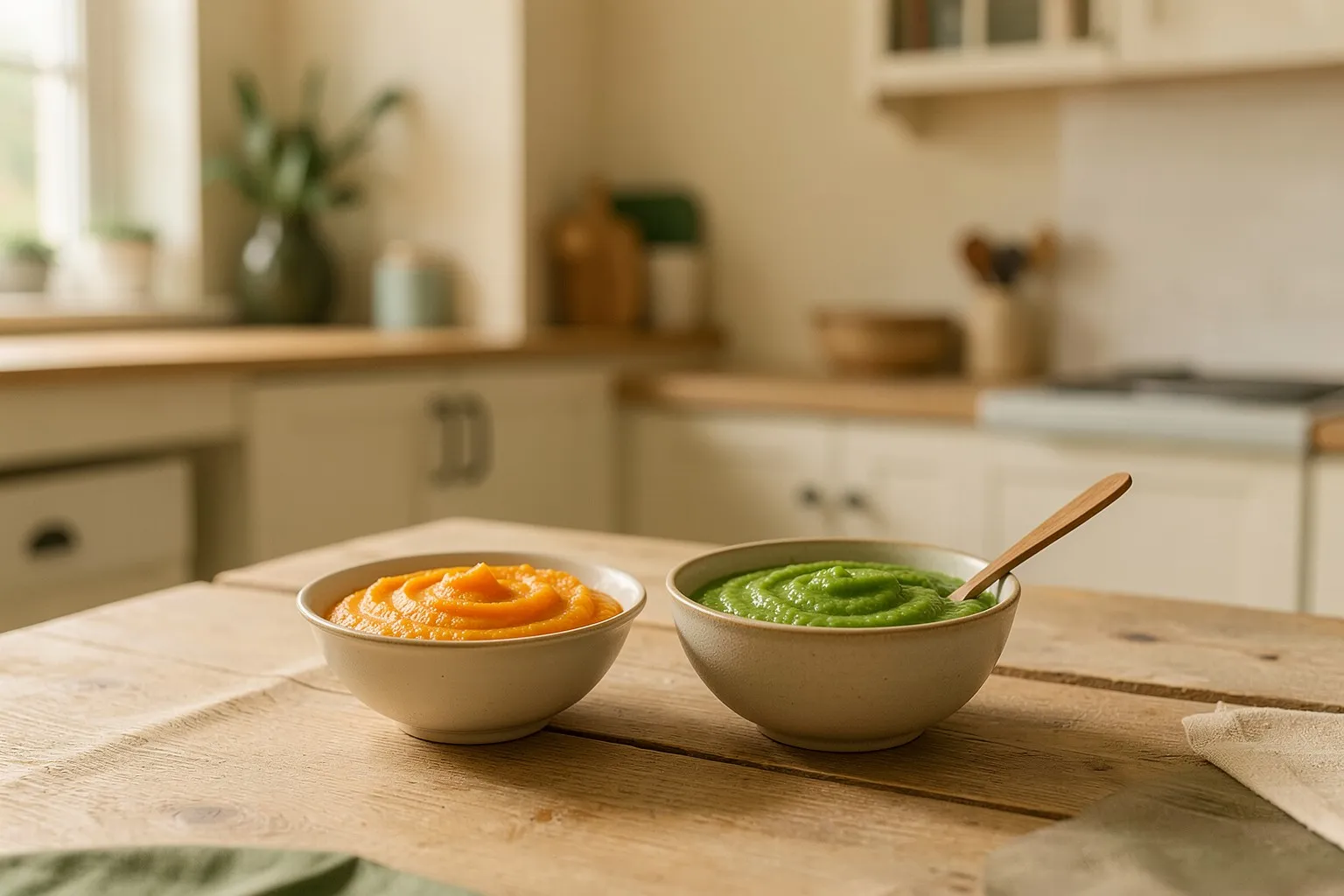
If you are comparing store-bought and homemade, two safety points apply:
- Storage time is short once opened. Purdue Extension lists opened or homemade strained fruits and vegetables at 2 to 3 days in the fridge and 6 to 8 months in the freezer, strained meats and egg yolks at 1 day in the fridge and 1 to 2 months in the freezer, and meat-and-vegetable combinations at 1 to 2 days in the fridge and 3 to 4 months in the freezer. For unopened jars, follow the use-by date.
- Texture can be a choking risk. The AAP says to start with soft or pureed food, avoid raw vegetables like carrot sticks and raw fruit chunks like apple pieces until age 4, cut grapes and round foods into tiny pieces (no larger than one-half inch), and supervise your baby at all times while eating.
Reheating, cooling and freezing rules for family meals are in our meal planning guide, and ideas for when your child moves past purees are in the quick, kid-approved snack recipes guide.
When should I start baby food, and what comes first?
Most babies are ready for solids at about 6 months. The AAP says breast milk alone is recommended for about 6 months, then foods are added while breastfeeding continues. The AAP also notes that babies who have doubled their birth weight (typically around 4 months) and weigh about 13 pounds or more may be ready, so ask your pediatrician before starting earlier.
Readiness signs from the 2025-2030 Dietary Guidelines:
- Sits up alone or with support.
- Controls head and neck.
- Opens the mouth when food is offered.
- Swallows food instead of pushing it back out onto the chin.
- Tries to grasp small objects and brings them to the mouth.
Start with a single-ingredient food from any food group. The AAP says you can introduce a new one every 3 to 5 days while watching for reactions. Breast milk or infant formula remains the main source of nutrition until 12 months.
What about allergens and juice?
Allergenic foods can go in baby food form. The AAP says babies without high-risk factors can begin peanut-containing products as early as 4 to 6 months, and that waiting past 4 to 6 months to introduce eggs, dairy, soy, peanut products or fish has no evidence of preventing allergy. Babies with severe eczema or an immediate reaction to a food, especially egg, should see a pediatrician first. The AAP also says babies younger than 12 months should not be given juice, so read pouch and drink labels carefully.
How do I make organic baby food worth the money?
You get the most value by buying organic for the foods your baby eats most and spending less on the rest. No sourced price comparison is available, so use these qualitative tips:
- Buy single-ingredient purees and combine them yourself, rather than paying for blends.
- Use frozen and canned vegetables and fruit without added sugar or salt for homemade purees. The AAP suggests frozen or canned produce without added sugar for busy families.
- Freeze ice-cube tray portions of homemade puree within the storage times above.
- Skip products with added sugars, sweeteners or syrups, whatever the organic label says.
For the broader picture, from first foods to school age, see our kids’ nutrition guide. If your baby has a reaction, trouble swallowing, poor weight gain or loose, watery stools that persist, call your pediatrician. For emergencies, call your local emergency number.
| Label wording | Organic content required | USDA seal allowed? | Organic ingredients marked in the ingredient list? |
|---|---|---|---|
| 100% organic | All ingredients organic | Yes (optional) | Optional |
| Organic | At least 95% organic | Yes (optional) | Required |
| Made with organic ingredients | At least 70% organic | No | Required |
For a first food with one ingredient, '100% organic' or 'organic' is easy to verify. For multi-ingredient blends, read the ingredient list, because a 'made with organic' label can still include non-organic ingredients.
FAQ
Is organic baby food better for babies?
Organic baby food is not proven safer for heavy metals. The FDA says organic crops absorb heavy metals from the soil just like conventional crops. Organic does mean the food met USDA production rules, which may matter to you for other reasons. For your baby's health, the bigger factors are a varied diet, age-appropriate texture and no added sugar or salt.
What does the USDA organic label mean on baby food?
It shows how much of the product is certified organic. '100% organic' means every ingredient is organic. 'Organic' means at least 95% is organic. 'Made with organic ingredients' means at least 70%, and that label cannot use the USDA seal. Packaged organic products must also carry a 'Certified organic by' statement naming the certifier.
Are there heavy metals in baby food?
Trace amounts of arsenic, lead, cadmium and mercury can be present because foods absorb them from soil, water and air. The FDA's Closer to Zero program aims to lower these levels in foods for babies and young children. Its advice for parents is to serve a wide variety of foods so a child is not repeatedly exposed to one source.
Should I avoid rice cereal for my baby?
The FDA notes that rice tends to absorb arsenic more readily than other crops, and recommends offering a variety of grains rather than relying on rice cereal alone, such as iron-fortified oat, barley and multigrain cereals. It does not say rice must be banned. Rotate grains and mix cereals with breast milk, formula or water. Ask your pediatrician about iron needs and which first foods suit your baby.
How long does opened baby food last?
Purdue Extension says opened or homemade strained fruits and vegetables last 2 to 3 days in the fridge, strained meats and egg yolks 1 day, and meat-and-vegetable combinations 1 to 2 days. For unopened jars, follow the use-by date on the package. If you are unsure how long something has been open, discard it rather than risk making your baby sick.
When can babies start eating baby food?
Most babies are ready at about 6 months. The AAP recommends only breast milk for about 6 months, and notes babies are typically around 4 months and 13 pounds or more before showing readiness. Look for readiness signs listed in the Dietary Guidelines: sitting up alone or with support, good head and neck control, opening the mouth for food, and swallowing instead of pushing food out.
Can I give my baby allergenic foods in baby food form?
Yes, often. The AAP says babies without high-risk factors can begin peanut-containing products as early as 4 to 6 months, and waiting longer has no evidence of preventing allergy. Babies with severe eczema or a past reaction to a food, especially egg, are higher risk, so talk with your pediatrician first. Introduce one new food at a time.
Sources
- USDA Agricultural Marketing Service: Labeling Requirements for the U.S. Organic Market (ams.usda.gov)
- FDA: Closer to Zero, Reducing Childhood Exposure to Heavy Metals from Foods (fda.gov)
- FDA: What You Can Do to Limit Exposure to Arsenic (fda.gov)
- AAP HealthyChildren.org: Choking Prevention for Babies & Children (healthychildren.org)
- AAP HealthyChildren.org: Recommended Drinks for Children Age 5 & Younger (healthychildren.org)
- AAP HealthyChildren.org: How to Reduce Added Sugar in Your Child's Diet (healthychildren.org)
- AAP HealthyChildren.org: When Can Babies Start Solid Foods? (healthychildren.org)
- AAP HealthyChildren.org: When to Introduce Egg, Peanut Butter and Other Common Food Allergens (healthychildren.org)
- Purdue Extension: Storing Leftovers (including baby food storage times) (extension.purdue.edu)
- Dietary Guidelines for Americans, 2025-2030 (HHS and USDA) (cdn.realfood.gov)
Related articles
- Best Nutrition for Kids: Meal Prep and Picky Eater Guide
What kids need to eat by age, how to handle picky eating, and how to meal prep safely, using AAP, CDC and USDA guidance.
- Family Meal Planning: A Week of Dinners and a Grocery List
Plan a week of kid-friendly family dinners with a five-step method, ten weeknight dinners, a free planner and grocery list, and safe food storage times.
- Healthy Snack Ideas for Kids: 10 Balanced, Safe Options
Ten healthy kids' snack ideas built on the AAP formula, with choking-safe cuts, portion sizes and added sugar limits from federal guidance.
- Family-Friendly Recipes: Healthy Dinners Kids Will Eat
Five simple healthy dinner templates for the whole family, with safe cooking temperatures, picky-eater swaps and leftover storage rules.
- Holiday Baby Gift Guide: Safe Gifts for Newborns and Infants
Researched holiday gift guidance for newborns and infants: safe toys, sleep gift dos and don'ts, battery and magnet rules, from AAP, CPSC and CDC.
- 14 Best Family Blogs and Parenting Websites to Follow
A checked list of 14 family blogs and parenting websites for health, activities, recipes and support, plus how to judge any parenting blog.